

[FR]
Vernissage vendredi 16 octobre en présence de l’artiste, 18h-21h
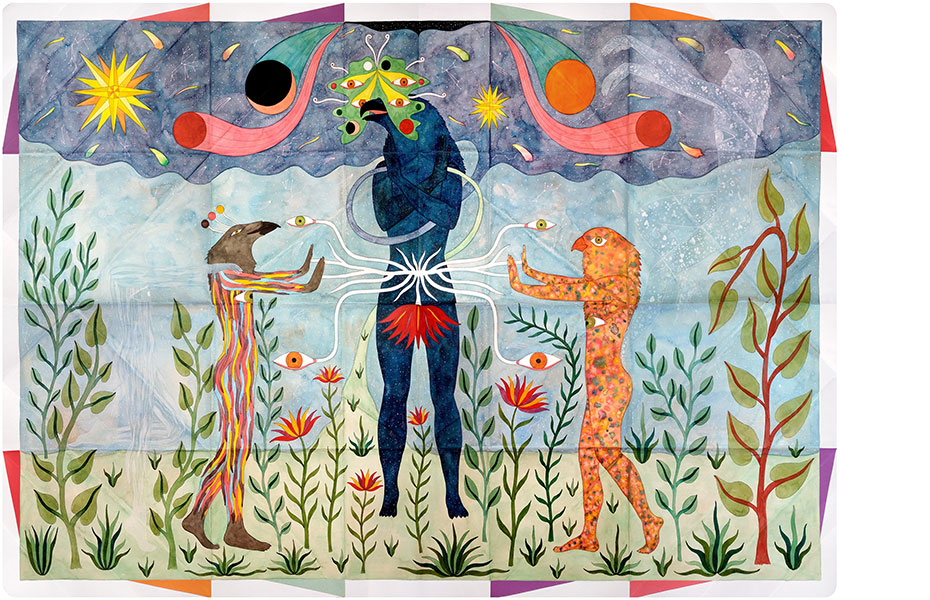
La galerie présente ‘The Dreaming Realm’, la troisième exposition personnelle de l’artiste visuelle indienne Rithika Merchant à Paris. Après ‘Mirror of the Mind’ (2019) et ‘Festival of the Phoenix Sun’ (2022), elle revient avec un ensemble inédit de 8 peintures sur papier poursuivant la construction d’une mythologie spéculative axée sur les questions écologiques et la conscience collective. Dans cette fable d’anticipation poétique, Rithika Merchant opère une transition de la crise environnementale vers une utopie collective, où l’humanité se réinvente grâce au soin, à la nature et aux astres.
The Dreaming Realm poursuit l’odyssée narrative que Merchant déploie à travers ses différentes séries depuis 2020. Elle y met en scène des figures récurrentes, des « êtres » servant de représentations allégoriques de l’humanité, confrontées aux transformations environnementales de l’Anthropocène et l’Holocène, périodes lors desquelles l’activité humaine a transformé la Terre de manière irréversible. Les séries initiales, ‘Birth of a New World’ (2020) et ‘Return to Stardust’ (2021), abordaient la prise de conscience de la crise écologique, la recherche de réponses dans l’observation des phénomènes astronomiques et la confrontation aux limites des ressources terrestres. La série ‘Terraformation’ (2022-2023) formalisait ensuite l’abandon du monde ancien et la recherche d’habitats alternatifs, tandis que ‘Pillars of Fruit and Bone’ (2023-2025), plus récemment, examinait les structures d’une société néo-primitive. Dans ce nouveau volet, Rithika Merchant s’appuie sur le biomimétisme pour concevoir des formes architecturales inspirées des mécanismes végétaux et organiques. Sa série en cours, ‘Interspecies Care’, marque une étape centrée sur l’organisation sociale, l’interdépendance, la réciprocité entre les espèces et le partage des savoirs.
Rithika Merchant intègre dans sa pratique un corpus de références théoriques, historiques et iconographiques faisant appel à la notion d’expérience empirique basée sur la perception sensorielle, au concept grec de Kairos pour interroger la subjectivité du temps, ainsi qu’à des recherches sur les Béguines du Moyen Âge. Ces communautés laïques de femmes autonomes, organisées à partir du XIIe siècle autour du soin et des pratiques artistiques, lui servent de modèle historique pour aborder les structures de soutien communautaire. Son processus de construction d’univers s’inspire également de la science-fiction spéculative : elle cite notamment la série littéraire Children of Time d’Adrian Tchaikovsky, les récits d’Isaac Asimov reliant futur et présent, ainsi que les univers visuels de films comme Dune (Lynch et Villeneuve), La Planète Sauvage, Alien ou Annihilation (Alex Garland, 2018). L’iconographie qu’elle développe dans son travail repose d’autre part sur un répertoire symbolique précis : le papillon de nuit (Luna moth) renvoie aux transitions et au monde des rêves, la structure cristalline du bismuth (un métal) symbolise le passage d’un état à un autre, et les manifestations sonores du corbeau évoquent les rituels d’apaisement.
Depuis sa précédente exposition à la galerie en 2022, le travail de Rithika Merchant a fait l’objet de plusieurs présentations institutionnelles majeures, parmi elles : la scénographie du défilé Dior Haute Couture au Musée Rodin (‘The Flowers We Grew’, 2025) ; ‘Animal !?’ au Fonds Hélène et Edouard Leclerc (commissariat Christian Andelete, 2025) ; un solo show sur Art Basel en Suisse (représentée par Tarq Mumbai, 2026) ; ‘Tarot! Renaissance Symbols, Modern Visions’ à la Morgan Library, New York (2026). Ses œuvres ont également été acquises pour les collections permanentes du Kiran Nadar Museum à Dehli et de la Firestorm Foundation à Stockholm (2026).
[ENG]
Show opening reception with the artist, Friday October 16, 6pm-9pm
Galerie LJ presents The Dreaming Realm, the third solo exhibition by Indian visual artist Rithika Merchant in Paris. Following Mirror of the Mind (2019) and Festival of the Phoenix Sun (2022), she returns with a new series of 8 paintings on paper, continuing to build a speculative mythology centered on ecological issues and collective consciousness. In this poetic speculative fable, Rithika Merchant charts a transition from environmental crisis to a collective utopia, in which humanity reinvents itself through care, nature, and the stars.
The Dreaming Realm continues the narrative odyssey that Merchant has been unfolding across her successive series since 2020. In these works, she features recurring figures—”beings” serving as allegorical representations of humanity—confronted with the environmental transformations of the Anthropocene and Holocene, periods during which human activity has irreversibly altered the Earth. Her early series, Birth of a New World (2020) and Return to Stardust (2021), addressed the growing awareness of the ecological crisis, the search for answers through the observation of astronomical phenomena, and the confrontation with the limits of Earth’s resources. The series Terraformation (2022–2023) then formalized the abandonment of the old world and the search for alternative habitats, while Pillars of Fruit and Bone (2023–2025), more recently, examined the structures of a neo-primitive society. In this new chapter, Rithika Merchant draws on biomimicry to design architectural forms inspired by plant and organic mechanisms. Her ongoing series, Interspecies Care, marks a milestone focused on social organization, interdependence, reciprocity between species, and knowledge sharing.
Rithika Merchant incorporates into her practice a body of theoretical, historical, and iconographic references, drawing notably on the notion of empirical experience based on sensory perception, the Greek concept of Kairos to question the subjectivity of time, as well as research on the Beguines of the Middle Ages. These lay communities of autonomous women, organized from the 12th century onward around care and artistic practices, serve as a historical model for exploring community support structures. Her worldbuilding process is also inspired by speculative science fiction: she cites Adrian Tchaikovsky’s Children of Time literary series, Isaac Asimov’s stories linking future and present, as well as the visual worlds of films such as Dune (Lynch and Villeneuve), Fantastic Planet (La Planète Sauvage), Alien, and Annihilation (Alex Garland, 2018). Furthermore, the iconography she develops in her work relies on a precise symbolic repertoire: the Luna moth refers to transitions and the realm of dreams, the crystalline structure of bismuth (a metal) symbolizes the transition from one state to another, and the vocalizations of the raven evoke rituals of soothing and comfort.
Since her previous exhibition at the gallery in 2022, Rithika Merchant’s work has been featured in several major institutional presentations, including: the scenography for the Dior Haute Couture show at the Musée Rodin (The Flowers We Grew, 2025); Animal !? at the Fonds Hélène & Édouard Leclerc (curated by Christian Andelete, 2025); a solo presentation at Art Basel in Switzerland (represented by Tarq Mumbai, 2026); and Tarot! Renaissance Symbols, Modern Visions at The Morgan Library, New York (2026). Her works have also been acquired for the permanent collections of the Kiran Nadar Museum of Art in Delhi and the Firestorm Foundation in Stockholm (2026).